The Quest for a Safer, Better Wet Season
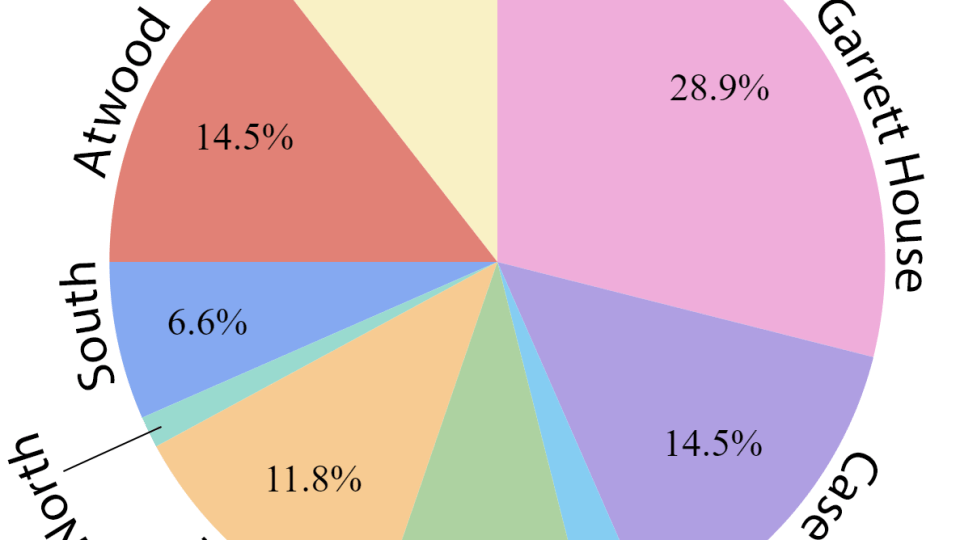
When Dry Week comes to an end, many students participate in Wet Season. Wet Season to some is a celebration of the end of dry week—a time to let go, relax, and enjoy yourself. For others, it can be a … Continue reading The Quest for a Safer, Better Wet Season

Mudd-Day
By Sarah Silcox Continue reading Mudd-Day
Punctual Punchlines: Puns for Prompt Petulance
What did the cowboy wear to work? A uniFARM! Why did the integer not want to date the Boolean? Because they they weren’t each others’ TYPE! What happens to magazines after they eat? They DIGEST! Why did the noodle try … Continue reading Punctual Punchlines: Puns for Prompt Petulance
Adventure Time: Mudd’s First-Ever Orientation Adventures
Many upperclassmen at Mudd fondly recall their Pre-Orientation backpacking trips, reflecting on the many miles they traversed, the colds nights under the stars, and, most importantly, the bonds they formed with their new classmates. Unfortunately, a majority of upperclassmen did not have the opportunity to participate in this trip. However, all the students in the Class of 2019 have memories of their Orientation Adventures–two-day excursions during New Student Orientation that could take the first-years anywhere, from the beach to Six Flags to the wilderness. Each OA trip consisted of 10 to 15 new students, 2 upperclassman leaders, and 1 faculty member. First-year Ben Iten … Continue reading Adventure Time: Mudd’s First-Ever Orientation Adventures
Claremont Weekend Activities
Claremont Walking Distance Weekend Activities! Do you consider yourself a busy student? Do you work hard all week, hoping that your sweat, blood, and tears will pay off in the form of weekend free time? Do you want to go out on the weekends, but don’t believe that you truly have enough time to enjoy yourself? Well, you might not have a whole day off to travel to Los Angeles, but I bet you have at least a couple hours to enjoy yourself! Listed below are a several food-places, bars, shops, parks, and free activities worth checking out — ALL … Continue reading Claremont Weekend Activities
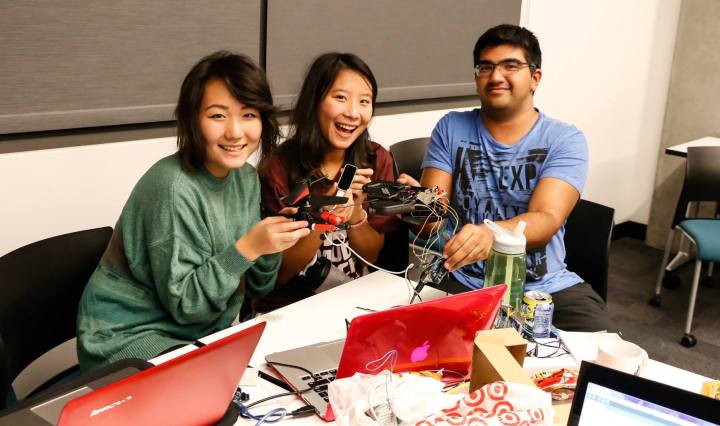
The 5C’s First Hardware Hackathon
What happens when you give Mudders 12 hours, tons of hardware, and free food? Insanely cool projects of course. From October 24th to 25th, Harvey Mudd hosted MuddHacks, the first hardware hackathon at the Claremont Colleges. Over 110 students, including … Continue reading The 5C’s First Hardware Hackathon
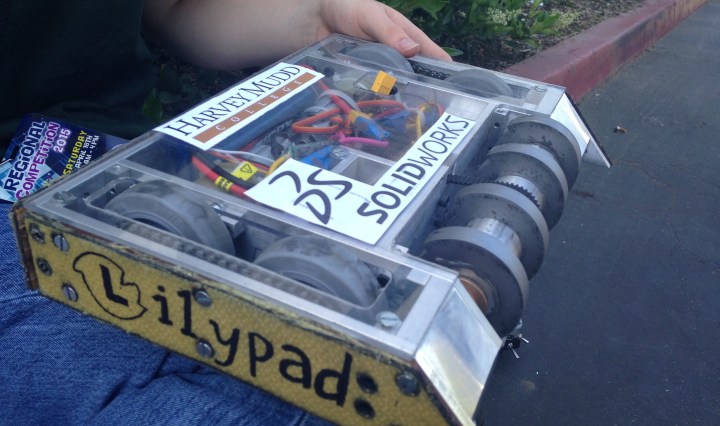
Combat Robotics’ Lilypad Takes “King of the Ring” Title
Combat Robotics club members: (Back row, left to right) Chris Kotcherha, Christine Goins, Jenny Smith, Kim Tran, Isabel Martos-Repath, Josephine Wong, Christina Zhu, Wenkai Qin, Jacob Rosalsky, (Front row, left to right) Adam Shaw, Jane Wu, Alex Goldstein Lilypad may … Continue reading Combat Robotics’ Lilypad Takes “King of the Ring” Title
Get Your Groan On: More Puns for Everyone
What did the smart triangle say to the dumb triangle? Stop being so OBTUSE! What did the pencil say to its boyfriend? You LEAD me on! What did the hook say to the jacket? How’s it HANGING? … Continue reading Get Your Groan On: More Puns for Everyone
Get Some Corny in Your Diet: Puns for Everyone
What do computers do in the winter? HIBERNATE! When do we get rain? When the sky is feeling blue! What did the tree say to the annoying squirrel? LEAF me alone! What did the bowling pin say … Continue reading Get Some Corny in Your Diet: Puns for Everyone
The Future of Biomedical Research in Professor Orwin’s Lab
About fifty thousand people each year in the United States experience corneal hazing, the impairment of vision by scar tissue on the cornea. Also occurring in staggering numbers, traumatic brain injuries affect about two million people yearly worldwide. In order to decrease those numbers, Professor Orwin and her lab have been working on two major projects involving injured cells in the body. One project focuses on rehabilitating injured cornea cells, and the other looks at brain cells damaged from the inflammatory response triggered after brain damage. For the cornea team, the techniques implemented include electromagnetic stimulation, mechanical stimulation, and the … Continue reading The Future of Biomedical Research in Professor Orwin’s Lab
 The Muddraker