
Article by Aleicia Zhu
Meet Prof. Wloka, who joined Mudd’s computer science department in 2021! Read on to learn about his path to becoming a professor, his Lab for CATS, and some of his hobbies and interests.

Q: Can you tell us about your time at university and grad school? Why did you choose to become a professor?
I had kind of a windy path. When I was two years old, I told my parents I was going to be a paleontologist. But when I was around thirteen, I realized that that would require a lot of digging in deserts — I grew up on a farm, so I’ve had many long days picking vegetables and helping out in various ways, and I had a strong desire to be in fewer dusty fields. I then wanted to be an astronaut, but soon realized I was too tall and my eyesight was too poor. Eventually, I decided that the next best thing would be to work on the rocketry and mechanisms that go into space. So, in undergrad, I studied aerospace engineering for three years at the University of Toronto.
Then, I interned at an automation company and worked on machine vision projects — it felt like solving a very fun puzzle, which I enjoyed. Reflecting on courses I’d taken over the past few years and reading more about what genuinely interested me, I realized that I really liked doing computation and learning more about how biological systems reasoned and thought. For example, I remember taking a robotics course in my second year — I enjoyed the puzzle aspect of trying to reason about and predict ahead of time what situations a robot might need to deal with, and figure out how to design mechanisms to overcome that. So, I switched programs. I finished my undergraduate degree in computational neuroscience, which incorporated a number of physiology courses as well as computer science courses.
From there, I looked for graduate school programs. I knew I still wanted to be in Toronto because my partner was finishing school, and her family was in the area. My choices were to either stay at the University of Toronto or move to York University, which happened to have the Center for Vision Research — integrating neuroscience, psychology, and computer science. One of my undergraduate mentors, Sven Dickinson, recommended I look into John Tsotsos’ lab there. John and I met and had great conversation, and I applied to work with him, going on to do both my Master’s and PhD with him. After I left York, I came here to work at Mudd.
Essentially, I had to try a number of different things before I figured out what I wanted to do. In addition to taking courses in a lot of different subjects, getting a chance during my internship to reflect on what I actually enjoyed was very important for figuring out my own path.
Q: Who is a role model to you?
My PhD supervisor, John, is a role model for me in terms of how I try to approach science as well as supervising students. He supported everyone in his lab, not only in terms of their academic and intellectual development, but also as a person. He is a computer scientist, but also does a lot of work in human vision and psychology. I am inspired by how he approaches interdisciplinary research; he spends a lot of time learning the relevant background and vocabulary to provide important contributions to multiple areas of research. That’s why I chose to work with him as a student, and today, I try to continue doing that myself.
Q: Can you tell us more about your Lab for CATS?
We don’t do any experiments with cats; it stands for the Lab for Cognition and Attention in Time and Space. Our general interest is trying to understand how to see — either as a human or as an artificial system — and how we understand our perception of the world.
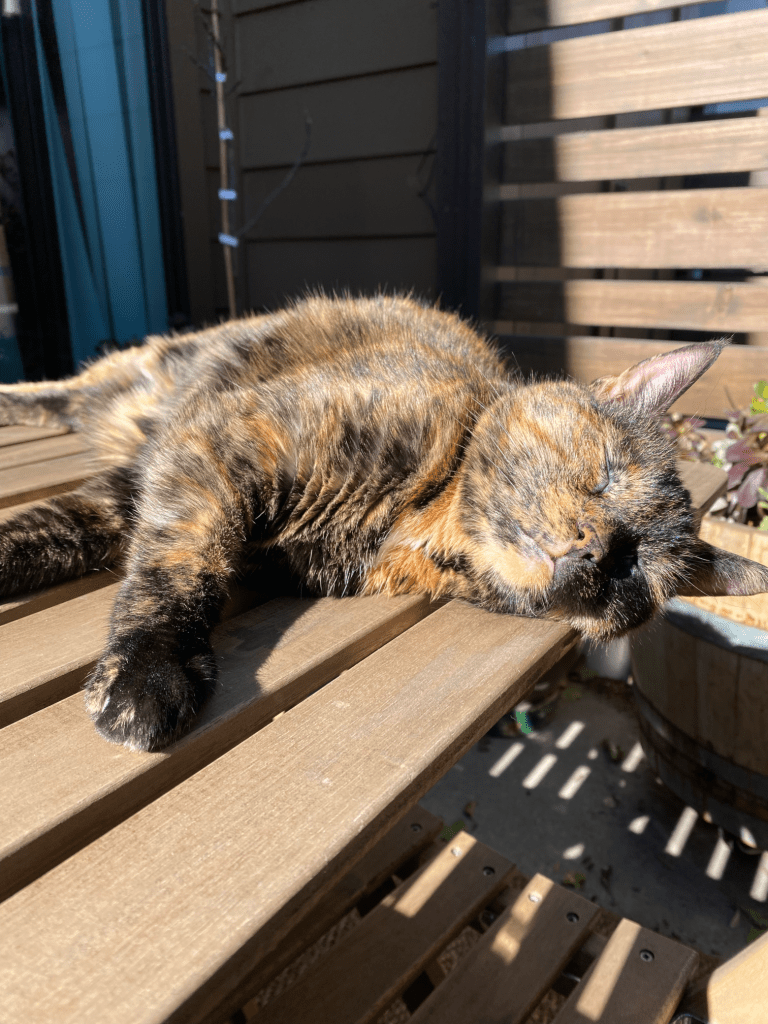
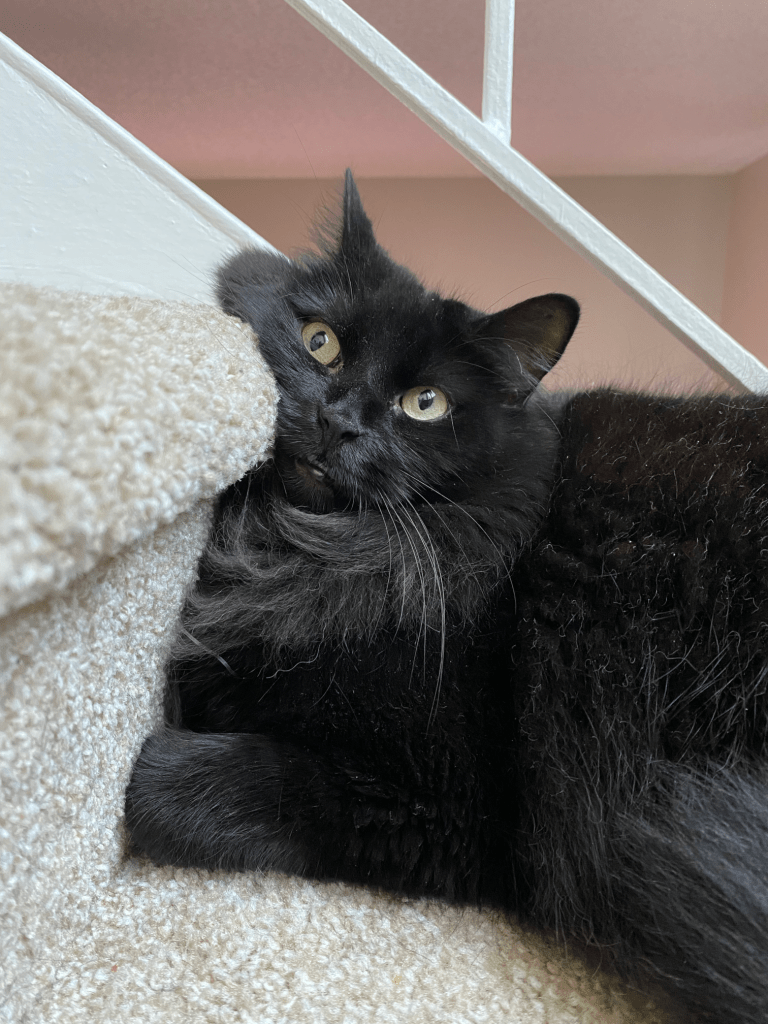
We work closely with Prof. Breeden, who is also a founding member of the lab (she has a cat, and I have two cats, so it seemed like an appropriate name!). Prof. Breeden brings expertise in eye tracking, along with her background in graphics and cinematography, which makes collaborating on experiment design a lot of fun.
Q: What student projects is the Lab of CATS working on?
Currently, I have students working on independent study projects in three areas.
One of them is an area we call action-attention. You might have a sequence of someone kicking a ball, and then the video processing network should label that as kicking. We’re interested in trying to understand what types of features these decisions are based on — are the networks actually incorporating the temporal features of the video (i.e. motion), or are they just seeing a ball and inferring it to be a kicking video? So we’re trying to understand if the networks are actually learning what we want them to learn, or instead finding shortcuts in the data. If we can answer that, we can potentially design data augmentation techniques to make a network’s learning more effective and use features that we think will generalize better, as well as provide methods to detect and perhaps mitigate bias in trained artificial intelligence systems.
A second group is working on eye tracking projects. One specific example is asymmetric search, which compares the behavior of deep neural networks to a biological intuition of how vision works. For example, if we consider a set of figures of people that are either upright or flipped, humans are faster at noticing a flipped figure because it’s unusual. But we found that learning-based saliency prediction models — deep networks that are designed to predict what people will fixate on — consistently predict the opposite, that the upright figures are more salient. Our hypothesis is that the images these models were trained on mostly contain upright figures; the unusual and unexpected objects are not well represented, and this seems to be a fundamental limit to learning. I’m not sure there is a way to remedy this because there are so many different ways something could be unusual or surprising — even if we add enough flipped humans to our training so the networks learn to predict them as salient, what if we instead turn them to the side or put them in funny clothing? There seems to be a conceptual limit to how well we can just learn from data alone, particularly when it comes to novelty detection.
I also have a third group of students called the tool-building group. This semester, they’re working on learning computer vision fundamentals through building computer vision code bases I can use for class demos, assignments, providing starter code for projects, and more. Based on what they learn from the process, they can extend their work into research projects in future semesters.
Q: Do you have any goals for this semester or academic year?
This semester, I’m teaching CS81 for the first time, and I’m excited because I really like the material, but since it’s my first time teaching it I’m also familiarizing myself with a lot of the course logistics and how best to present the content. My goal is to make sure I get a good handle on the course this semester while I have Prof. Stone co-teaching with me before I teach it solo next semester.
Q: What are some hobbies you enjoy doing in your free time?
After all of my childhood desire to flee the outdoors, I actually really enjoy spending time outside; on the weekend I’ll often go with my family to the Botanic Gardens. Since I grew up in a very different biome than the one found in Claremont, I really enjoy learning about the plants and animals that live here.
Q: Is there anything that you would like students to know?
I don’t drink coffee, but I do drink tea. People always ask if you want to go for a coffee, but no one ever asks if you want to go for a tea.
 The Muddraker